
Hybrid Inverters
One inverter for grid, solar and battery
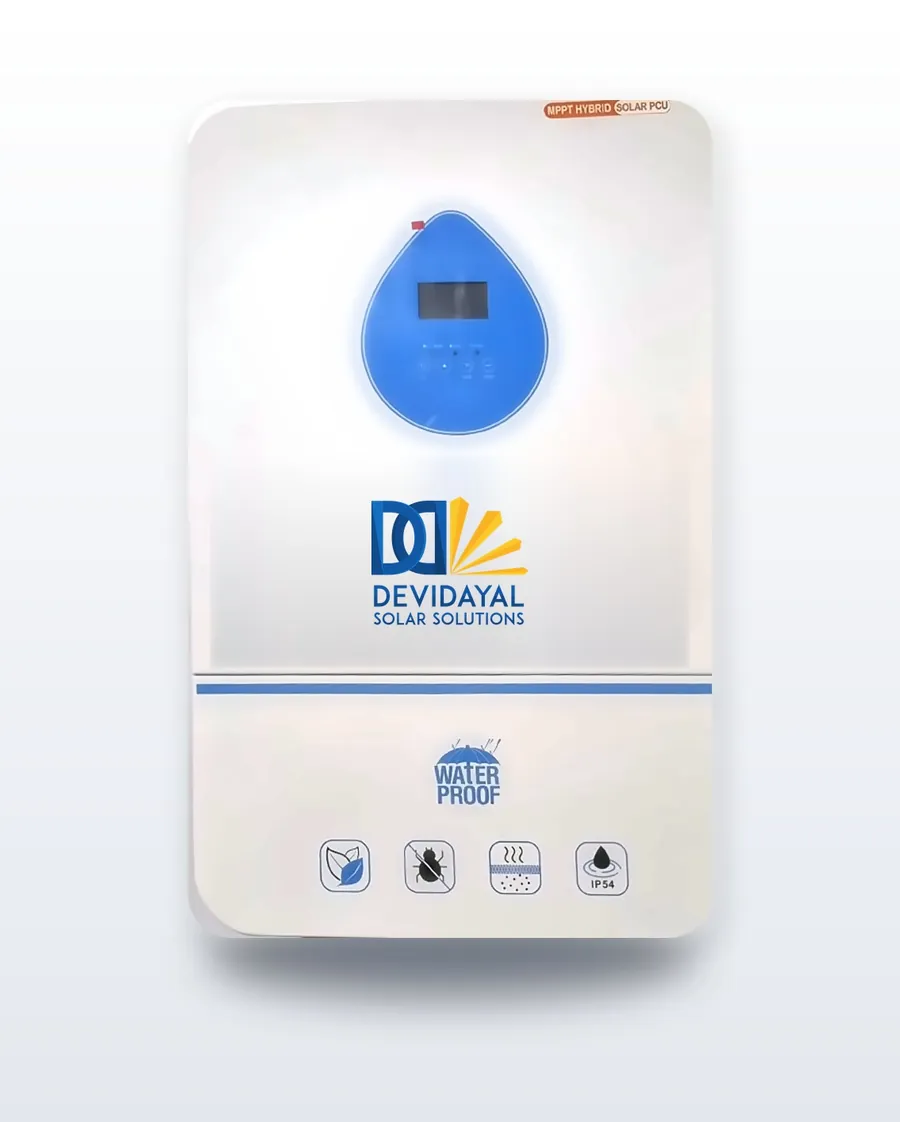
The DD-HYBRID series is a 3-in-1 solar inverter / PCU. It runs on-grid, off-grid or hybrid, switches between sources on its own, and keeps shops and homes powered through cuts and low voltage. Six models from 3.8 to 12.1 kVA.
Why customers choose it
Built for patchy grids and tight budgets
Runs when the grid doesn’t
Switches between solar, grid and battery automatically and accepts a 180–265 V grid supply, so shops stay open through power cuts and low voltage.
Works without a battery
Battery-free mode lets a customer start on solar alone and add storage later: a much lower entry price and an easier first purchase.
Sends surplus to the grid
Daytime surplus is exported instead of wasted. Works with lithium and lead-acid banks, so the customer chooses the battery.
At a glance
Six models, one platform
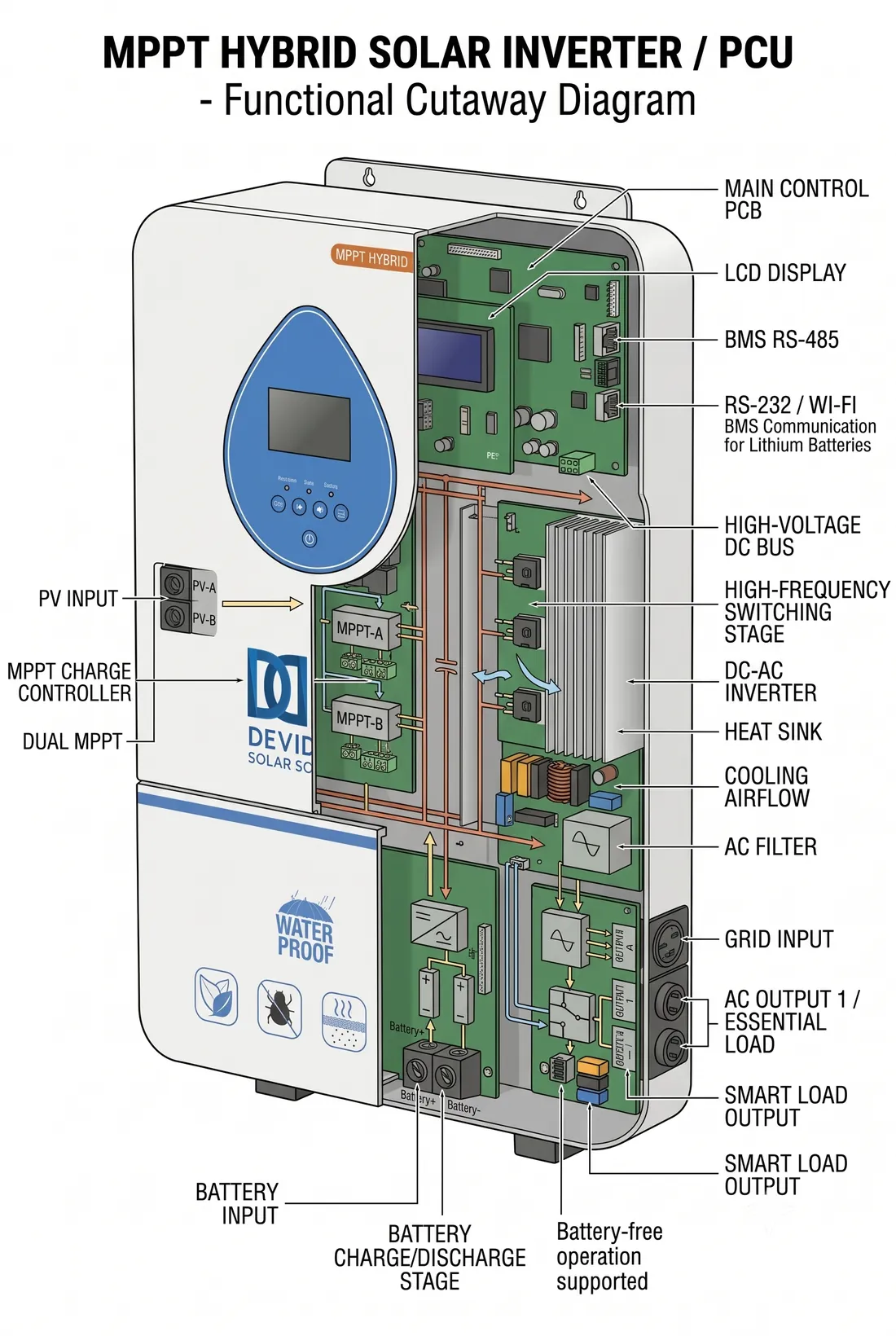
Illustrative cutaway. Tap to enlarge.
Inside the DD-HYBRID
Features that matter on site
- Adaptive energy modes: on-grid, off-grid and hybrid in one unit.
- Maximum solar harvest: MPPT charging (dual MPPT on higher models), pure sine wave output.
- Transformerless, high-frequency build: higher efficiency, lighter and more compact.
- Dual outputs: smart load management across two circuits.
- Built-in BMS communication: RS-485 port for lithium battery packs.
- Remote monitoring: RS-232 port for an external Wi-Fi module.
- Parallel operation for larger loads.
- Made for rural sites: improved dust filter and a larger, clearer display.
How it connects
Solar, grid and battery, managed for you
The inverter decides, moment to moment, which source feeds your loads and where any surplus goes.
Technical specifications
Pick the model that fits the load
24 V models for small shops and homes, 48 V models for larger loads. Dual MPPT on the 10 and 12 kVA units.
| Model | DD-HY 3.8K-24 | DD-HY 4.4K-24 | DD-HY 6.6K-48 | DD-HY 7.5K-48 | DD-HY 10K-48 | DD-HY 12K-48 |
|---|---|---|---|---|---|---|
| Rated capacity | 3850 VA | 4400 VA | 6600 VA | 7500 VA | 10000 VA | 12100 VA |
| PV input | ||||||
| PV charging mode | MPPT | MPPT | MPPT | MPPT | Dual MPPT | Dual MPPT |
| Max. input power | 4000 W | 5000 W | 7000 W | 7500 W | 10000 W | 11000 W |
| MPPT operating voltage | 60–500 Vdc | 60–500 Vdc | 60–500 Vdc | 90–450 Vdc | 90–500 Vdc | 90–500 Vdc |
| Best MPPT voltage range | 300–400 Vdc | |||||
| Max. input current | 18 A | 18 A | 25 A | 16 A / 16 A | 18 A / 18 A | 18 A / 18 A |
| Battery | ||||||
| Battery type | Li-ion / Lead-acid / SMF | |||||
| Rated battery voltage | 24 Vdc | 24 Vdc | 48 Vdc | 48 Vdc | 48 Vdc | 48 Vdc |
| Battery voltage range | 21–32 Vdc | 21–32 Vdc | 42–64 Vdc | 42–64 Vdc | 42–64 Vdc | 42–64 Vdc |
| Max. charging current | 120 A | 120 A | 120 A | 120 A | 150 A | 150 A |
| On-grid | ||||||
| AC in/out active power | 3500 W | 4000 W | 6000 W | 6800 W | 9000 W | 11000 W |
| AC in/out apparent power | 3850 VA | 4400 VA | 6600 VA | 7500 VA | 10000 VA | 12100 VA |
| Output current | 15.7 A | 17.4 A | 26.1 A | 30.0 A | 34.8 A | 47.8 A |
| Rated input | L + N + PE | |||||
| Output voltage | 220 V / 230 V / 240 V | |||||
| Grid frequency (in/out) | 50 / 60 Hz | |||||
| Grid voltage range | 180–265 VAC | |||||
| Power factor | > 0.99 | |||||
| Off-grid output | ||||||
| Max. output apparent power | 3850 VA | 4400 VA | 6600 VA | 7500 VA | 10000 VA | 12100 VA |
| Output voltage | 220 V / 230 V / 240 V | |||||
| Rated output frequency | 50 / 60 Hz | |||||
| Output waveform | Pure sine wave | |||||
| General | ||||||
| Display | LCD showing running mode, load, input and output | |||||
| RS-232 port | External Wi-Fi module | |||||
| RS-485 port | Lithium battery BMS communication, Wi-Fi card, dry contact | |||||
| Parallel operation | Available if required | |||||
| Outputs | Dual output available | |||||
| Operating temperature | −10 °C to 50 °C | |||||
| Humidity | 20% – 95% (non-condensing) | |||||
| Altitude | Up to 1000 m; derating above, max. 4000 m (IEC 62040) | |||||
| Noise | 50 dB | |||||
| Standards & certification | BIS approved · IEC 62109-2 · IEC 62116 | |||||
Specifications are indicative and subject to change without notice. Actual output depends on site conditions, panel configuration and battery type. Swipe sideways on mobile to see all models.
Who it is for
Where the DD-HYBRID earns its keep
Kirana, retail & small business
Lights, fans, freezers and billing stay on through cuts; daytime solar cuts the electricity bill.
Homes
Start on solar alone with no battery, then add lithium or lead-acid storage when the budget allows.
Clinics, schools & offices
Dual outputs keep essential circuits on battery while other loads run on solar and grid.
Common questions
Hybrid inverters, answered
Do I need a battery?
No. The DD-HYBRID supports battery-free operation, so you can start on solar and grid only and add a battery later. With a battery, it also keeps your loads running during power cuts.
Which batteries does it work with?
Lithium-ion, lead-acid and SMF batteries. The 3.8 and 4.4 kVA models use a 24 V bank; the 6.6 to 12.1 kVA models use 48 V. Lithium packs communicate with the inverter over the built-in RS-485 BMS port.
Can it send surplus power to the grid?
Yes, daytime surplus can be exported instead of wasted. Exporting to the grid needs a net-metering connection approved by your electricity distribution company; we can guide you through it.
Which model do I need?
It depends on your connected load and how many hours of backup you want. Share your load list or electricity bill with us and we will size the inverter, panels and battery together.
Can I monitor it remotely?
Yes. An external Wi-Fi module connects through the RS-232 port and reports performance data remotely. The front LCD shows running mode, load, input and output on site.
What about warranty and service?
Every unit carries a replacement warranty and is serviced through our Uttar Pradesh service network. Ask us for the warranty terms for your model.
Tell us your load. We will size the system.
Share what you need to run and for how long. We will recommend the right DD-HYBRID model, panels and battery, and send a quote.